Posts

Proxy-Aware Payload Testing

Image
TL;DR - I get told that I am too wordy, so if you want the summary, here are some steps to setup a virtual testing environment to test payloads to see if they can handle HTTP(S) proxies and if so, can they authenticate properly through them as well. This post will cover the proxy setup without authentication since that is the easier part, and I will do a second post shortly to hack together the authentication portion of it. Skip down to the actual setup here if you wanted to skip the fluff. Introduction: There have been times in my red teaming and pentesting experience that I have run into networks where direct outbound traffic to the internet (or in some cases out of the subnet) is completely restricted. When I say direct, I mean that all DNS traffic first goes to an internal DNS server, all web traffic goes through an internal proxy, email to an internal SMTP/IMAP server, etc. From the client workstation to any internet IP address is dropped for TCP, UDP, and ICMP....
Finding Hidden Treasure on Owned Boxes: Post-Exploitation Enumeration with wmiServSessEnum

Image
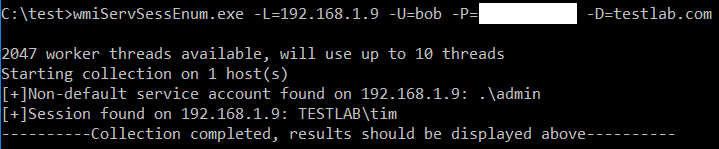
TLDR: We can use WMI queries to enumerate accounts configured to run any service on a box (even non-started / disabled), as well as perform live session enumeration.  Info on running the tool is in the bottom section. Link to Github:  https://github.com/G0ldenGunSec/wmiServSessEnum Background On a recent engagement I had gotten local admin privileges on ~20 boxes, and after querying active sessions on them got me nothing interesting I was ready to look for other potential escalation paths.  I ran secretsdump against several of the systems to grab local account hashes, and found that in the process of running it, I had also obtained plaintext credentials for a domain account that was not mentioned in any of the session enumeration information I had pulled.  This got me thinking about how this was possible, as well as how I could more reliably hunt for similar configurations on other systems I could remotely execute code on. First, to explain what was go...

SharpExec - Lateral Movement With Your Favorite .NET Bling

Image
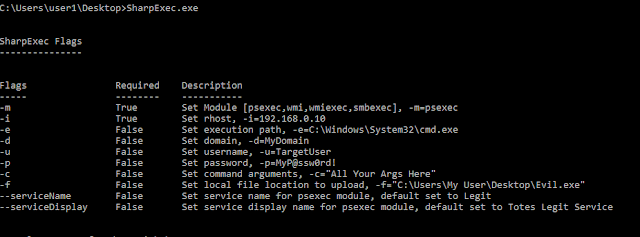
TL;DR: SharpExec is an offensive security C# tool designed to aid with lateral movement. While the techniques used are not groundbreaking or new by any means, every environment is different and what works for one situation might not work for the next.  This tool is a combination of code I have been using over the years when needing to move laterally in a Windows environment and due to various circumstances traditional tools weren't an option.  Below I will go over functionality, benefits, things to be aware of, etc.  If you are already tired of reading this, you can grab the source code or compiled tool from my github here:  https://github.com/anthemtotheego/SharpExec Current modules: WMIExec - Semi-Interactive shell that runs as the user. Best described as a less mature version of Impacket's wmiexec.py tool. SMBExec - Semi-Interactive shell that runs as NT Authority\System.  Best described as a less mature version of Impacket's smbexec.py tool. P...

Red Teaming Made Easy with Exchange Privilege Escalation and PowerPriv

Image
TL;DR: A new take on the recently released Exchange privilege escalation attack allowing for   remote usage without needing to drop files to disk, local admin rights, or knowing any passwords at all.   Any shell on a user account with a mailbox = domain admin.  I wrote a PowerShell implementation of PrivExchange that uses the credentials of the current user to authenticate to exchange.  Find it here:  https://github.com/G0ldenGunSec/PowerPriv   The Exchange attack that @_dirkjan released last week ( https://dirkjanm.io/abusing-exchange-one-api-call-away-from-domain-admin ) provides an extremely quick path to full domain control on most networks, especially those on which we already have a device that we can run our tools on, such as during an internal network penetration test.   However, I saw a bit of a gap from the point of a more red-team focused attack scenario, in which we often wouldn’t have a box on the internal client network that w...

SharpNado - Teaching an old dog evil tricks using .NET Remoting or WCF to host smarter and dynamic payloads

Image
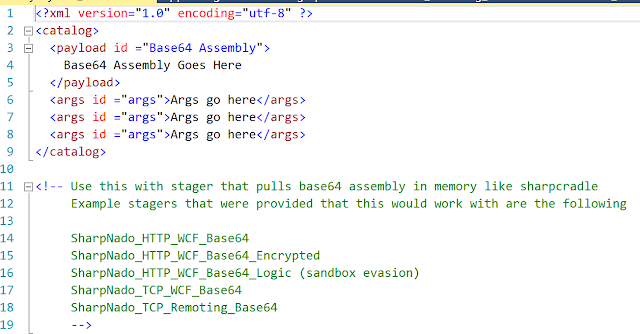
TL;DR: SharpNado is proof of concept tool that demonstrates how one could use .Net Remoting or Windows Communication Foundation (WCF) to host smarter and dynamic .NET payloads.  SharpNado is not meant to be a full functioning, robust, payload delivery system nor is it anything groundbreaking. It's merely something to get the creative juices flowing on how one could use these technologies or others to create dynamic and hopefully smarter payloads. I have provided a few simple examples of how this could be used to either dynamically execute base64 assemblies in memory or dynamically compile source code and execute it in memory.  This, however, could be expanded upon to include different kinds of stagers, payloads, protocols, etc. So, what is WCF and .NET Remoting? While going over these is beyond the scope of this blog, Microsoft describes Windows Communication Foundation as a framework for building service-oriented applications and .NET Remoting as a framework that allows...

Popular posts from this blog

No Shells Required - a Walkthrough on Using Impacket and Kerberos to Delegate Your Way to DA

One Click to Compromise -- Fun With ClickOnce Deployment Manifests

Executing Macros From a DOCX With Remote Template Injection